HIGHMARK STADIUM
STADIUM DUDE’S NFL STADIUM RANK: #9
STADIUM INFORMATION
- Location: Orchard Park, NY
- Opened: 2026
- Capacity: 60,128
- Weather: Uncomfortable (ranked the worst of the 20 outdoor venues)
- Games attended: 1
- Last visited: 2026

STADIUM REVIEW
The Bills Mafia is certifiably nuts. The tailgate is among the craziest, booziest, and rowdiest in football. You want to see grown-ass men jump off RVs in an attempt to smash through a flaming portable table? This is the place. I’m convinced the excessive pregame binge-drinking numbed this dedicated fan base into repeatedly coming out in snowy weather for decades of mediocre football during the long years between Jim Kelly and Josh Allen.
And now they have a shiny new palace worthy of their passionate love. The new Highmark Stadium isn’t perfect. Or practical. But it’s a fine place to watch a game.
Built For Noise
A new venue always has a little extra pomp and circumstance when it first opens. Demand for seats will be high as everyone wants to check out the new digs. This leads to inflated secondary-market ticket prices and often shuts out the blue-collar hardcore fan. This didn’t seem to be the case in Buffalo; at least, the place sounded like it was filled with REAL fans. It’s loud. Really loud.
Part of this is just the passion that Western New Yorkers have for their team. These are some of the best fans in football.
And part of it is by design.
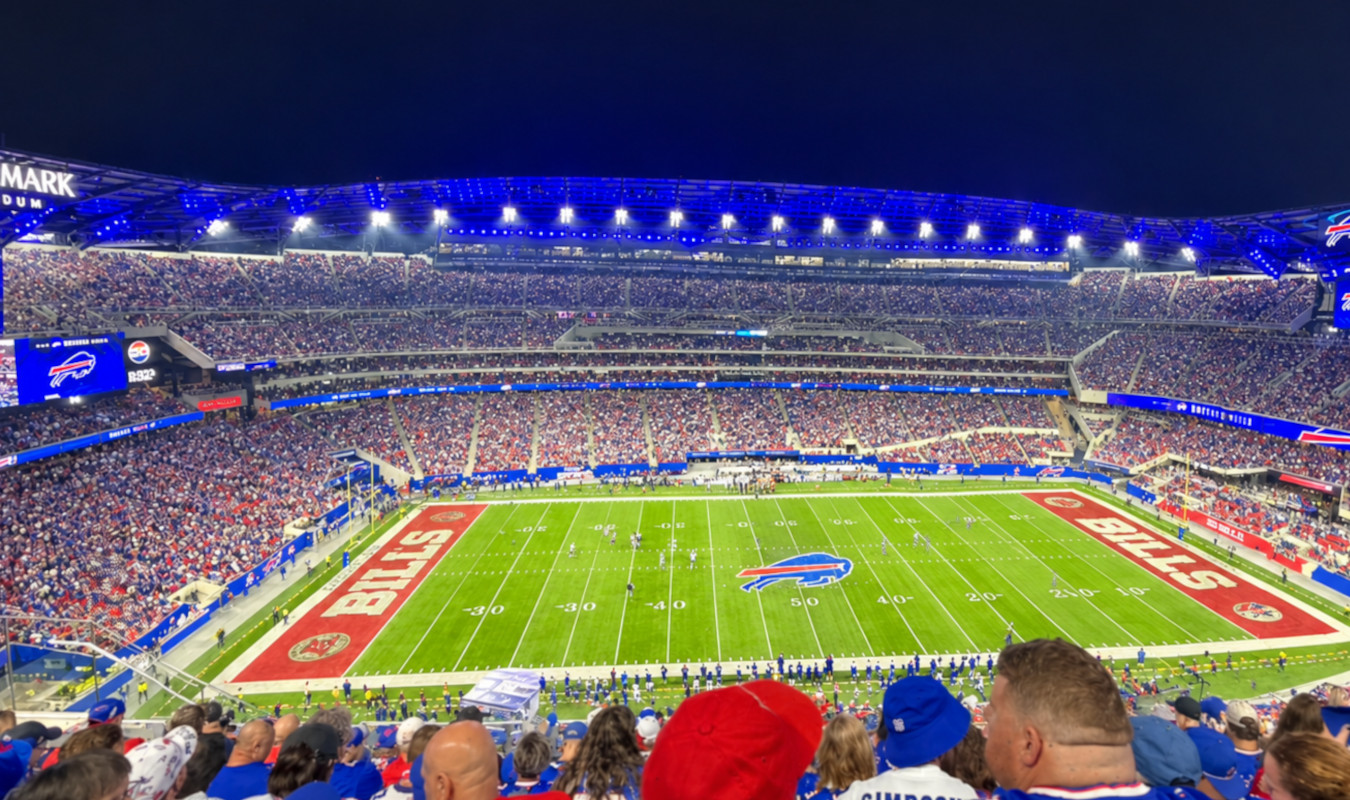
The stadium has a steep, vertical seating design that stacks fans closely on top of the action. The 360-degree rigid steel canopy reflects crowd noise directly back down to the field. Add a massive 750,000-watt sound system with more and larger subwoofers than any other stadium in the U.S., and you have a cacophony that will likely yield plenty of opposing false starts. The home-field advantage is real.
A Purist’s Stadium
Taxpayers contributed $850 million in public funds to the $2.1 billion edifice, the largest public subsidy ever committed to an NFL facility.
From a taxpayer’s standpoint, it would have made a lot of sense to build an indoor facility in the city of Buffalo that could double as convention space and potentially host year-round events. And an indoor facility would guarantee a more comfortable fan experience. Bills fans are cursed with some of the worst weather in football. There seems to be a “snow-out” that affects at least one home game every year. Orchard Park, New York, frequently records historic amounts of lake-effect snow because it sits directly in the primary snowbelt downwind of Lake Erie.
Instead, they built an open-air venue to preserve team tradition and weaponize cold-weather home-field advantages.
They didn’t move it to a more urban setting; they built it next to the old one in the suburbs. Much of the tailgate experience of the old stadium carries over. Unless your season ticket comes with team-controlled parking, you’re breaking tables and shotgunning Genesee in someone’s backyard.
The new venue is on the smaller side. Its seating capacity of 60,108 is about 11,000 seats fewer than the old stadium. Rather than packing in more bleachers, they made the seats bigger. Concourses are wider, and both the upper and lower decks have wraparound views of the field.
They went with a natural-grass playing surface in a market where turf would make sense, given the number of times they need to plow the field. Players prefer natural grass; let’s see how it holds up in the winter.
I could make the argument that, for a billion dollars of tax money, a more practical, year-round stadium would have made sense. But the team wanted to keep its tough winter-weather identity. And Buffalo fans overwhelmingly wanted to keep playing outdoors. The romantics won.
Making Outdoor Football Work in Buffalo
They’ve accounted for the weather somewhat.
The aforementioned canopy shields about 60% of fans from rain or snow (and provides shade for the one or two potentially hot early-season games). The outer walls of the stadium are perforated to regulate airflow and prevent strong winds from dipping into the bowl, reducing field-level wind speeds by up to 50%. The stadium has the world’s largest stadium snow-melt network, with roof sensors that monitor and automatically melt snow accumulations. Concourses and premium club zones are heated. And the natural-grass playing surface features underground heating coils to prevent freezing.
What Else Works?
The place has a modern look. The exterior shell is good-looking. And the lighting effects make night games a spectacle.
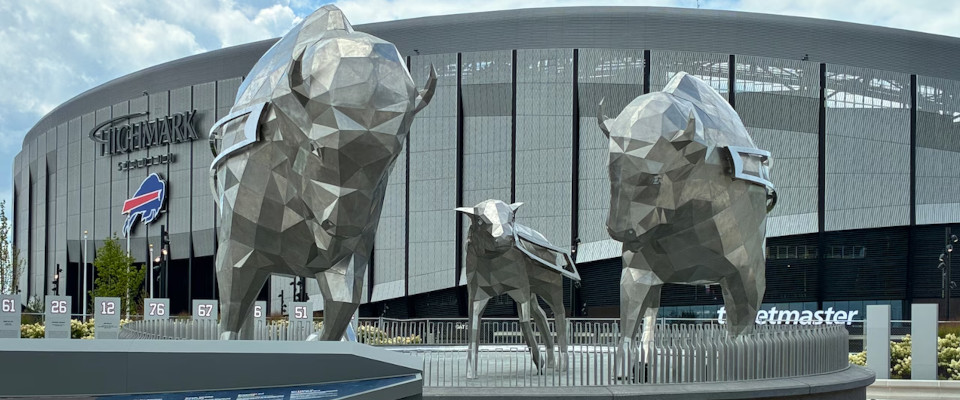
The massive bison sculptures are cool. The bull, the cow, and the calf represent strength and the spirit of the team’s fans. And they look really neat at night.
There’s a 20-foot-tall sculpture of a broken plastic folding table as an homage to the drunken ritual of body-slamming grown men wearing Zubaz pants in the name of team spirit.
Washrooms are plentiful, and concession lines moved well (except for the long line for the Labatt beer horn).
And finally, in an era of needless tensions between Canada and the U.S., the Bills acknowledge their fans from the North by playing both the Canadian and American anthems pregame. With 18% of the PSL license deposits coming from Southern Ontario, this makes good business sense. And despite some nattering on the Twittersphere, it’s embraced with fans loudly singing BOTH anthems. We CAN get along.
Why Isn’t It Ranked Higher?
There are a few downsides.
The biggest is the number of obstructed sightlines. The Bills wanted a 360-degree concourse where fans leaving their seats could still maintain a partial line of sight to the field. So architects from Populous placed stairwells and access steps on the leading edge of the upper-level concourses (outboard/in front of the seats) instead of ducking them underneath the seating tiers. This places walkways directly in front of the lower rows in the 300 and 400 levels. In addition, to protect fans walking along these aisles and concourse edges, thick glass panels and metal railings were installed. Both directly intersect the sightlines of spectators sitting in the front rows of upper sections, especially those close to the aisle.
The video boards are decidedly underwhelming. They feel small for a new venue. According to the franchise, the smaller size is meant to keep fans focused on the live action on the field rather than staring at giant displays, but they may have underdelivered.
Traffic in and out is still nightmarish, given the relative lack of ingress and egress options. It was in the old place as well. Heaven help you if you’re also battling a foot of fresh snow.
The canopy doesn’t protect 24,000 fans from rain or snow. And late-season games will still be uncomfortable for all but the hardiest fans.
Final Verdict
It’s way better than the place it replaced. As it works out some kinks, it should mature well, given its timeless design. Despite the flaws and the relative lack of bells and whistles compared with some of the other top venues, it’s a Top 10 stadium.